
Luxury hospitality has become very good at creating concepts. It has spent a decade building more distinctive hotels, resorts, and retreats — wellness-led, place-led, design-led, culturally led, membership-led.
In the process, the basis of the premium has quietly moved. For years, a luxury property charged a product premium: you paid more for the marble, the location, the square meters, the name above the door. Today those advantages are widely held. The premium has shifted to something harder to build and far harder to hold — a promise premium. The guest is no longer buying a room. They are buying a specific promise about how they expect to feel.
The concept became more sophisticated. The operation often did not.
The concept is now the price of entry
Guests increasingly choose between concepts, not amenities. Research from Skift points to the steady growth of experiential and wellness luxury — forms of luxury organized around meaning and personal relevance rather than visible status. McKinsey notes that travelers are "no longer content with a one-size-fits-all experience." Deloitte's luxury travel research found that 68% of travel advisors report their clients are increasingly choosing experiences tailored to what they value most.
Beautiful design is common. Wellness is common. Strong storytelling is common. A distinctive concept has become the price of entry, not the source of differentiation.
So the competitive question has changed. It is no longer "Is the concept compelling enough to attract demand?" It is "Can the operation make the concept believable every day?"
You can copy the marble.
You can copy the menu.
You can copy the concept.
You cannot copy the lived experience once it passes through people.

The body knows the difference before the mind does. Guests rarely explain it — they simply don't return. Good service is everywhere. Service that could only belong to your property is not. That distance is what this work closes.
A concept is an operational contract
The more specific the concept, the more specific the operation must become. A wellness retreat cannot run like a palace hotel. A culturally immersive property cannot run like a members' club. A discreet hideaway cannot run like a social resort.
Every promise the brand makes creates an operational obligation. A property that promises restoration sets different expectations for pace, staffing behavior, and recovery than one that promises grandeur or social energy. A property that promises intimacy owes a different service than one that promises predictability.
The concept no longer lives in the brand deck. It lives in the operational moments where the guest discovers whether the concept is real.
Deloitte Digital observes that luxury guests increasingly want to be "immersed in the product's story." But guests do not experience a concept through marketing. They experience it through people. The responsibility for carrying the promise sits inside daily operations.
This is where most properties feel the friction. The architecture supports the concept. The design supports it. The website and the marketing support it. The guest journey often does not. The service is professional, the standards are met, the LQA scores hold — and the guest still leaves feeling that something did not connect. Not because the operation failed. Because it delivered luxury — but not this luxury.
Why the promise premium is a commercial position
This is not only a guest-experience issue. It is a pricing one. Twenty years ago, location, product, scarcity, and brand recognition could carry the premium. Today competitors hold those same advantages. As they neutralize, the promise premium is protected by one thing: the operation's ability to make the concept believable under pressure, every shift.
The operation determines how much of the promise survives into performance.
When the concept survives daily delivery, pricing authority strengthens — rate resistance falls, return desire rises, owner confidence holds. When concept delivery becomes inconsistent, the commercial signs rarely appear all at once. They show up gradually: more leadership correction, weaker consistency, more uneven reviews. When guests still admire the property but hesitate at the rate, the issue often appears commercially before it appears operationally.
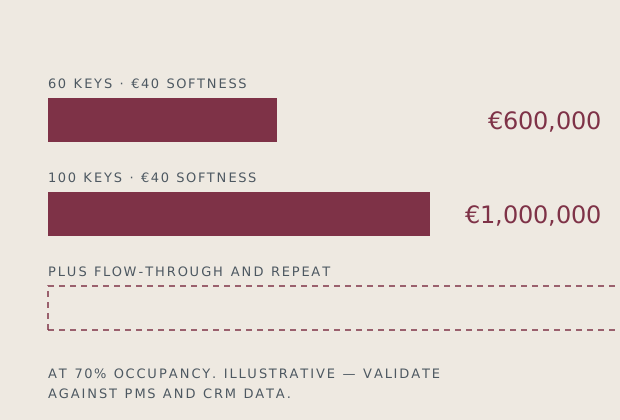
The commercial risk does not need to be dramatic to become material. On a 60-room luxury property, even a €40 ADR softness linked to weaker value perception can represent more than €600,000 in annual room revenue exposure at 70% occupancy. On a 100-room property, the same €40 softness approaches €1 million annually. That is before considering flow-through, repeat demand, direct booking confidence, or the cost of replacing guests who did not feel enough attachment to return.
The point is not that every concept-delivery issue creates an immediate measurable ADR drop. The point is that, in a premium market, even small shifts in perceived value can become material when multiplied across rooms, nights, and repeat demand.
This is why concept delivery is not a brand exercise. It is an operating discipline with commercial consequences.
The premium is no longer protected by the concept alone. It is protected by the operation's ability to make the concept true.

The general manager's new mandate
This shift is quietly rewriting the GM's role. Operational performance is still the floor. But increasingly the GM is also accountable for governing concept continuity — keeping the promise intact across departments, leadership changes, and seasons, long after opening excitement fades.
The question moves from "Are we meeting the standard?" to "Are we delivering the experience we claim?" The stronger the concept, the more leadership attention required to keep it operationally true — and the rarer it is for any one role to own whether all of it still adds up once the hotel is alive and full.
The missing discipline
That ownership is the missing piece. Branding creates the emotional idea. Design stages it. Standards describe it. Almost no one tests whether guests actually feel it — and locates where it breaks when they don't.
That is the work of concept delivery consulting: treating the promise as a structure to be carried across service, atmosphere, and daily operations, not a claim to be re-stated in marketing. The Concept Legibility Method™ reads whether the concept survives delivery — where the promise stops traveling, and what it costs when it does.
The next competitive advantage
Luxury hospitality spent the last decade differentiating concepts. The next decade will be won by the operators who can deliver those concepts consistently under pressure.
In an industry built on differentiated concepts, the rarest capability is no longer creating the story. It is making the story consistently believable — because that is where pricing authority, guest loyalty, owner confidence, and long-term asset defensibility now live.
The product premium is over. The promise premium is the work.