Concepts are rarely abandoned. They stop governing anything.
The question is not whether the idea is still on the wall. It is whether anyone on the floor is still using it to decide.
Luxury hospitality concepts rarely lose meaning because someone consciously abandons the idea.
They lose meaning because the idea is treated as a launch narrative rather than an operating system.
On opening day, the concept is unusually well protected. The designers, brand team, opening leadership and trainers are still close to the property. Employees are learning not only what they are supposed to do, but why particular choices were made.
The distinctions are fresh.
Why arrival should feel informal rather than ceremonial.
Why service should sometimes be restrained rather than highly visible.
Why recommendations should reveal something particular about the destination rather than simply secure whatever is popular.
Why one perfectly acceptable luxury-service behavior belongs here and another does not.
Then the hotel begins operating. Occupancy rises. Employees leave. New employees arrive. Managers solve practical problems. Procedures are adjusted. Commercial priorities intervene. Shortcuts that work become habits.
Very little of this looks like failure.
That is exactly why concept drift is difficult to see.
The property can remain beautiful. Service can remain polished. Standards can still be followed. Guests may continue leaving positive reviews.
Yet gradually, the decisions being made by the operation stop being governed by the idea that made the property distinctive.
The hotel does not necessarily become worse. It becomes more generic: polished, efficient, expensive, and increasingly interchangeable.
At opening, the concept still has interpreters
During development and pre-opening, unusual choices can still be explained.
If a property is intended to feel closer to a private residence than a traditional hotel, someone can explain why the arrival experience should not resemble a conventional check-in.
If the concept is restorative, someone can explain why more attention is not always better attention.
If discovery is part of the proposition, someone can distinguish between providing access and providing genuine local intelligence.
The people closest to the concept still remember what each detail is supposed to accomplish.
After opening, that changes. The original concept creators leave. The opening team disperses. New managers inherit decisions whose reasoning they may never have heard.
The property is no longer being interpreted by the people who created it.
The operation itself becomes the interpreter.
And eventually, the operation becomes the teacher.
New employees inherit behavior before they inherit meaning
A new employee rarely learns a concept only through a brand book.
They watch their colleagues.
They notice what managers correct.
They see which shortcuts are tolerated.
They learn which standards matter when the property is busy.
They discover how experienced employees actually behave when the guest asks for something that does not fit the script.
This is how operational culture forms.
It is also how meaning can slowly move.
A deliberate behavior becomes a routine.
The routine becomes a standard.
The standard survives.
The reason behind it disappears.
That creates a particular vulnerability in luxury hospitality: the organization may preserve the visible ritual while losing the judgment that made the ritual meaningful.
Once that judgment disappears, the team may know what normally happens but not what should happen when circumstances change.
A concept is more than a collection of behaviors. It determines which behavior is appropriate for this particular property, guest and moment.
The drift often happens through reasonable decisions
Consider a hotel built around discovery and a strong relationship to place.
At opening, the concierge team has spent months developing local knowledge.
They know the small restaurant that makes sense for the guest who wants dinner somewhere unpolished and very good.
They know which gallery is worth seeing now, rather than which one appears on every travel list.
They can distinguish between the beach a first-time visitor will enjoy and the one a returning guest might appreciate precisely because there is very little there.
The concierge is doing more than arranging reservations.
The team is helping make the property's relationship to place credible.
Then employees leave.
New concierges arrive.
They inherit an existing list.
Management naturally prefers partners that are dependable: restaurants that answer, guides who never cancel, drivers who can reliably handle last-minute requests.
Nothing about that is unreasonable.
Over time, the list narrows.
The same restaurants are recommended repeatedly.
The same private tours.
The same luxury boutiques.
The same beach club.
Every recommendation remains perfectly defensible.
The concierge desk may still be excellent. Responses are fast. Reservations are secured. Cars arrive on time.
But a guest staying at a hotel supposedly built around discovery increasingly receives the same itinerary they might receive from another luxury property across town.
Nothing failed operationally.
The service remained competent.
What began as local intelligence became luxury access.
That is concept drift. It can usually be dated by asking who last had to explain a decision rather than repeat it.
The distinction did not disappear because somebody rejected it. It disappeared through a series of sensible operating decisions that gradually changed what the hotel was optimizing for.
Pressure exposes what the organization really understands
Most concepts are easier to deliver when occupancy is low, staffing is complete and nothing unusual is happening.
The more revealing moment is a sold-out weekend.
A peak arrival period.
A staff shortage.
A guest request that falls outside the usual sequence.
Under pressure, operations simplify.
They have to.
The important question is what they simplify toward.
If the organization understands the governing logic of the concept, employees can adapt while protecting what matters most.
If the organization mainly understands procedures, pressure tends to expose something else: the generic operating logic sitting underneath the concept.
The relaxed property becomes procedural.
The personal property becomes bureaucratic.
The restorative property becomes interruption-heavy.
The property promising effortless service transfers coordination back to the guest.
The place-rooted concept begins behaving like any competent international luxury hotel.
Pressure does not necessarily create the problem. It often reveals that employees were taught what normally happens without being given enough understanding of what the experience is trying to protect.
Generic excellence can be more dangerous than obvious failure
A serious service failure is relatively easy to identify.
The room was not ready.
The luggage went missing.
The reservation was wrong.
Concept drift is harder because everybody may be doing their jobs well.
The employee can be courteous.
The SOP can be followed.
The guest's request can be fulfilled.
And the experience can still become less credible.
This is where consistency and credibility separate.
Repeating a behavior reliably does not automatically make it right for the concept. Standards are useful when they preserve something meaningful. They become dangerous when consistency itself becomes the objective.
A private-residence concept should not automatically become more formal because a new manager associates formality with luxury.
A restorative retreat should not introduce more verbal engagement merely because guest-contact scores are being monitored.
A culturally rooted property should not replace difficult-to-maintain local distinctions with internationally recognizable luxury gestures simply because they are easier to standardize.
All of those decisions could be defended individually.
Together, they can produce a property that performs luxury competently while communicating less and less about why this particular place exists.
A property can avoid obvious mistakes and still fail to create enough positive evidence for its proposition to feel real.
The concept needs to tell the operation which good thing matters more
Luxury hospitality presents constant conflicts between desirable outcomes.
Privacy or recognition?
Ceremony or speed?
Consistency or personalization?
Generosity or restraint?
Authenticity or familiarity?
Efficiency or meaning?
There is no universal answer.
The answer depends on what the property is trying to be.
This is one of the jobs of a strong concept after opening: to keep helping the organization decide, long after anyone has stopped explaining. It help the organization decide which value should win when two reasonable versions of good hospitality conflict.
Without that hierarchy, teams default to familiar definitions of luxury.
And familiar definitions produce familiar hotels.
Leadership determines whether distinction survives
Pre-opening training cannot preserve a concept indefinitely.
Eventually, managers become its custodians.
Not because they need to repeat the brand narrative in every briefing, but because hundreds of apparently minor operating decisions accumulate into the guest experience.
What gets corrected?
What gets rewarded?
What shortcut becomes acceptable?
Which ritual is protected when the property is busy?
When does an employee have permission to depart from the default?
When a new procedure solves an operational problem, does anyone ask what it changed about the experience?
Concept drift accelerates when those questions disappear.
The operation gradually learns that efficiency, consistency, risk reduction or habit are the real governing priorities, regardless of what the property continues to say about itself.
The concept remains in the presentation.
Another logic begins governing the floor.
The commercial problem is not bad service
A luxury property can remain successful while some degree of drift occurs.
Not every inconsistency matters. Not every compromise threatens the proposition.
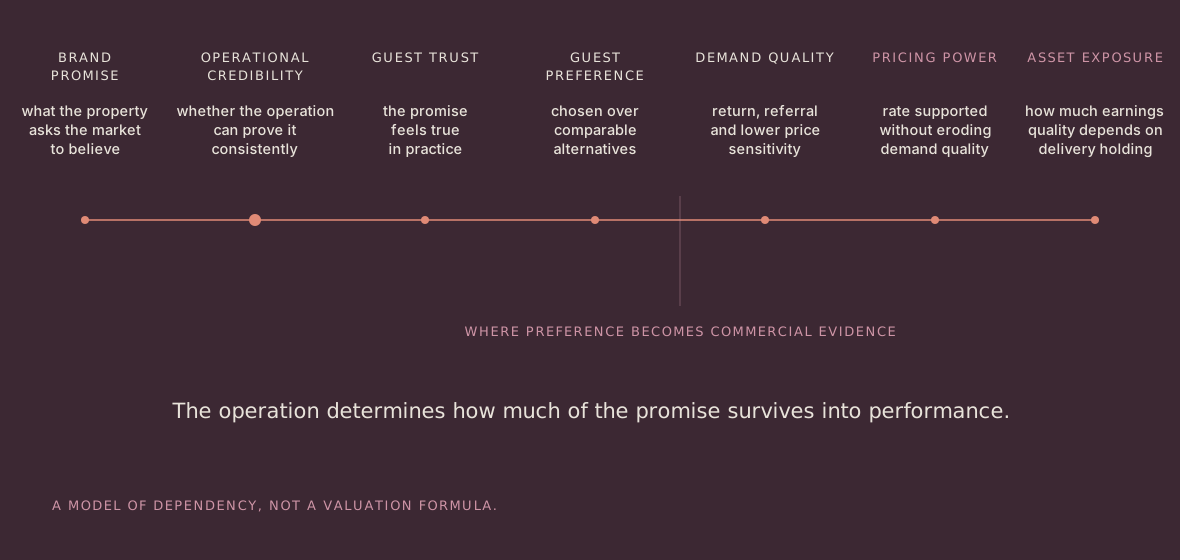
The problem becomes more important when the thing being diluted is central to why the guest chooses the property or accepts its premium.
A property marketed around privacy eventually has to provide evidence of discretion and control.
A hotel claiming a profound connection to place eventually has to behave in ways that could not be transferred to another destination.
A highly personal concept eventually has to demonstrate continuity rather than merely record preferences.
Architecture, photography and positioning can create desire before arrival.
After arrival, the operation has to provide evidence that the distinction is real.
When that evidence weakens, the issue is not necessarily that guests receive poor service.
It is that the property becomes less able to answer a much more commercially important question:
Why this hotel rather than another very good one?
Opening the concept is not the same as sustaining it
The difficult test of a hospitality concept does not happen on opening night.
It happens months and years later.
After the opening team has left.
After turnover.
After the first difficult season.
After operating procedures have been changed.
After managers have inherited decisions they did not make.
After commercial pressure has tested which distinctions the organization is genuinely willing and able to protect.
A concept survives when the organization can continue making choices that express its governing idea even as the circumstances around those choices change.
That requires more than remembering the story.
It requires preserving the judgment behind it.
Because luxury concepts rarely disappear dramatically.
They become less specific.
Less deliberate.
Less recognizable.
Until eventually, the property still looks exactly like the concept that was created. But the operation no longer gives the guest enough evidence to understand what made it different in the first place.