
A guest checks out. The bag is brought down at the right minute. The car is waiting. The farewell is warm enough.
She writes the review later, on the plane. Beautiful property. Lovely staff. Everything was right. She gives it four stars. She does not book it again.
Nothing failed. Nothing she could point to. She just did not feel pulled back.
This is the harder distance in luxury hospitality. Not the loud failure. The quiet one. The kind that doesn’t show up in a complaint, doesn’t show up in a score, and shows up — eventually — in the booking she never makes.
Luxury is not only judged by whether the action happened.
It is judged by whether the action carried what it was meant to carry.
This is the distance industry literature describes but rarely diagnoses. The work below names it, locates it, and explains where it tends to break.

1. Visible excellence is not the same as what the guest carries home
Many luxury properties are very good at visible excellence.
The room is composed. The lobby is immaculate. The staff are well-dressed. The greeting is rehearsed. The amenities are in place. The language is refined.
But a guest doesn’t experience luxury as a checklist.
She experiences tone. Timing. Pacing. Recognition. The sense of being received instead of processed.
That is where the distance begins.
A property can appear flawless and still fail to create attachment. The guest may respect the polish but never feel personally connected. She remembers how the place looked. Not how the stay made her feel.
In luxury hospitality, admiration alone is not enough.
The guest has to carry something with her.
2. The problem is not always bad service
When service feels cold, scripted, or impersonal, the issue is usually treated as a skill problem. Use the name. Smile more. Repeat the welcome sequence. Retrain the gesture.
Sometimes that is the right move.
Often it misses the deeper break.
The problem is not that the team doesn’t know the action.
The problem is that the action has become disconnected from the meaning it was designed to create.
A greeting is not only a greeting. It is meant to create arrival.
A name is not only a personalization technique. It is meant to create recognition.
A handoff is not only a transfer between departments. It is meant to create continuity.
A recovery is not only a solution. It is meant to restore trust.
When those meanings stop being carried, the service can be correct and still feel wrong.
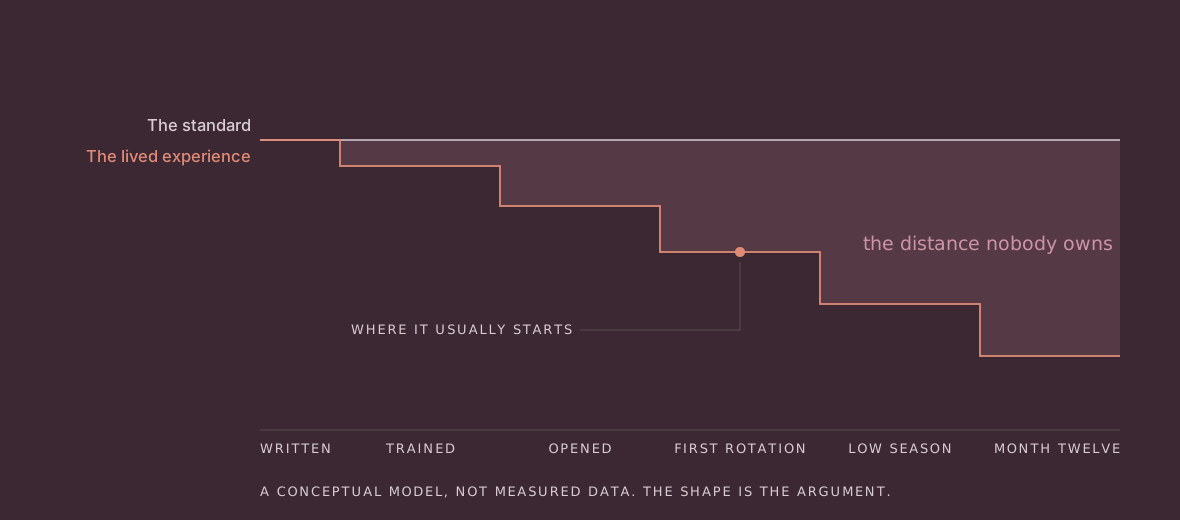
3. The standard became an action. The action did not become an experience.
This is the hidden break.
The first translation happened.
The standard became a behavior.
The second translation failed.
The behavior did not become an experience the guest could feel.
The welcome happened. The guest did not feel welcomed.
The name was used. The guest did not feel known.
The room was explained. The guest did not feel settled.
The issue was solved. The guest did not feel reassured.
This is the difference between compliance and lived delivery consistency.
A technically correct action can carry the wrong pace, tone, register. Too fast. Too rehearsed. Too distant. Too focused on completion instead of reception.
The action happened. The meaning did not.
This is the Standards-to-Delivery distance. It is not a service standards problem. It is a translation problem — the moment the standard stops becoming the stay.
4. What guests say instead
Guests rarely describe this in operational language.
They don’t say the standard failed to carry the intended emotional outcome.
They say simpler things.
- The hotel was beautiful, but the service felt cold.
- The staff were polite, but it felt impersonal.
- Everything looked perfect, but something was missing.
- The property was stunning, but I would not rush back.
- It was nice, but not memorable.
- It did not feel worth the price.
That language matters.
It points to a distance between the visible product and the inhabited one.
The guest admired the property. Did not attach to it.
The service was performed. Did not create emotional consequence.
The experience looked luxurious. Did not become memory.
That is where premium positioning becomes vulnerable.
A guest can be satisfied and still not return. Praise the design and still forget the warmth. Recognize the effort and still feel no pull back.
This contradiction appears in public commentary across the entire market. Reviews of widely-admired luxury properties — historic European hotels, flagship ski resorts, lakeside retreats, brand flagships in the most photogenic cities in the world — repeat the same words: beautiful but cold. Polished but impersonal. Luxurious but not worth returning to. The details vary. The shape is the same. The visible product is admired. The inhabited one is not.
5. Why this happens inside strong properties
This problem appears inside properties that already have many things right.
The concept was developed by a serious firm — AvroKO, Studio KO, sometimes the in-house creative of a Belmond or an EDITION. The interiors are by Champalimaud, Pierre Yovanovitch, Pinto Paris, Liaigre. The service standards were written against Forbes Travel Guide or LQA criteria. The team was trained — sometimes by John Paul, sometimes by an internal academy, sometimes by a former GM the owner trusts.
These are excellent firms. None of them is the fault.
Each of those choices is right.
And the experience can still weaken between the building and the bed.
That weakening happens between the standard and the person delivering it.
It shows up in tone, in timing, in the judgment someone makes with no line to fall back on. In whether the person at the desk has enough of the idea to improvise, and enough room to try.
This is rarely because staff are careless.
It happens because the emotional intent behind the standard has not been made operational enough to survive real conditions: different shifts, different personalities, busy arrivals, tired teams, unclear handoffs, inconsistent managers, pressure from guests, recovery moments, the moments where the script runs out.
This is why one staff member can make the property feel generous. Another can make the same property feel procedural.
One interaction creates ease. Another creates distance.
One team member reads the guest. Another completes the task.
One shift carries the concept. Another flattens it.
The problem is not the absence of standards. The standards exist. The intended feeling depends too much on individual instinct.

6. Recognition is not a detail. It is a system test.
Recognition is where this distance appears most clearly.
Many luxury properties talk about personalization. Personalization is not the same as recognition.
Personalization can be a note in a system.
Recognition is when that knowledge becomes felt by the guest.
A preference remembered by one excellent staff member is meaningful. It is not yet property-level recognition.
If the memory disappears when the shift changes, the guest feels the seam.
That seam matters.
The guest doesn’t experience departments separately. She experiences the property as one continuous promise.
If the restaurant remembers her and reception does not.
If the spa understands her and housekeeping does not.
If one manager creates warmth and another resets the relationship to zero —
the guest feels the inconsistency. Even when each person is technically doing the job.
The question is not whether someone remembered something.
The question is whether the property carried recognition across people, roles, moments, time.
That is where luxury begins to feel personal instead of performed.
Industry commentary on emotional luxury makes a related point: many properties personalize operationally — CRM notes, preference tags, repeated phrases — without ever creating the sense of being known. The personalization is documented. The recognition is not delivered. Invisible to the system. Entirely visible to the guest.
7. The distance behaves differently in luxury and ultra-luxury
The Standards-to-Delivery distance shows up in both tiers. It does not behave the same way in each.
In standard luxury, excellent and consistent is often enough. A Forbes-trained team, a well-run service sequence, a clean handoff. The guest may not feel deeply known, but she feels well taken care of. The premium is justified by quality, location, and reliability versus other options at the same rate. Correct still passes.
In ultra-luxury, the same delivery starts to fail.
At Cheval Blanc, Bulgari, Belmond’s flagships, Aman, the owners are no longer paying staff to perform service. They are paying for the felt singularity that justifies the rate. The guest is not asking was the standard met. She is asking did this property recognize me, anticipate me, hold a world around me that no other property could have held.
When the answer is no — when the welcome was correct but unsurprising, when the recognition was scripted but not specific, when the experience could have belonged to three other properties she could also have booked — the premium becomes harder to defend, regardless of how much was spent to build it.
In ultra-luxury, the distance weakens the rate.
That is the operational difference. And it is why the diagnostic question matters more at the top of the market — not less.
8. The commercial cost
This distance is expensive because it hides behind acceptable performance.
There may not be a dramatic complaint. The review score may stay decent. The guest may not ask for compensation. The team may believe the interaction was handled correctly.
The cost appears elsewhere.
In weaker return desire.
In guests who praise the property’s beauty more than the feeling of being there.
In management correcting the same behaviors without changing the underlying experience.
In a property depending too much on press, design, or novelty to keep attracting new guests.
In staff consistency that depends on a few strong individuals rather than a system that helps everyone carry the concept.
In a premium that is visually justified but not emotionally justified.
This is also how brand erosion begins. Not through a dramatic failure, but through repeated experiences that make the property’s specific promise less believable. The hotel remains admired, well reviewed and visibly luxurious while becoming less distinct in the guest’s mind.
As that distinction weakens, the brand has to work harder to recreate preference — through design, novelty, communications or price — rather than having the lived experience reinforce it. Each of those is a cost. None of them is as durable as the thing they replace.
The premium is not protected by polish alone. It is protected when the stay creates memory, trust, and pull-back.
Loyalty in this market is rarely created by polish. Guests return when the experience feels specific, reliable, and personally meaningful enough to remember.

9. The better diagnostic question
Most teams ask: Was the standard followed?
That question matters. It is not enough.
The better question is: Did the standard carry the intended experience?
Did the greeting create arrival?
Did the name create recognition?
Did the pace create ease?
Did the tone create warmth?
Did the handoff create continuity?
Did the recovery restore trust?
Did the staff behavior reinforce the world the property promised?
This is where service moves beyond compliance.
A standard is not successful because it was performed.
A standard is successful when it protects the feeling it was designed to create.
10. What needs to be diagnosed — after opening, and before it
When luxury service is technically correct but still feels wrong, the answer is not more training.
Training helps when the issue is skill.
When the issue is translation, the first step is diagnosis.
After opening, the Concept to Experience Diagnostic looks at where the intended experience weakens in live delivery — when polish has stabilized but warmth has not, when the team has settled into the procedural version of the standard rather than the lived one.
Before opening, the diagnostic stress-tests the standards against the shifts that will actually run them, the handoffs that will actually happen between departments, the recognition moments that depend on systems and people who have not yet met each other. It asks whether the standard, as written, will carry what the concept promised — given the team being hired and the operation being designed. The earlier the distance is named, the cheaper it is to correct.
In both cases the diagnostic asks where:
- standards are being followed but not felt
- service actions are correct but emotionally flat
- staff behavior contradicts the intended atmosphere
- handoffs weaken continuity
- recognition depends too much on individual memory
- managers correct actions instead of meaning
- guests feel processed instead of received
- the property creates admiration without attachment
The goal is not to criticize the team.
The goal is to locate where the property’s promise stops becoming the stay.
Once that break is visible, it becomes correctable.
Closing
Luxury service can look polished from the outside and still fail at the level that matters most: how the guest feels at the moment of leaving.
The action can happen. The standard can be met. The sequence can be followed.
If the guest does not feel received, recognized, settled, reassured, or drawn back, the service has not done its work.
For properties with strong concepts, strong standards, and beautiful environments — whether already open or preparing to open — the next question is not how to improve service.
It is more precise.
That is the diagnostic work.
The distance between the audit score and the lived experience is the distance between the rate the property charges and the rate the property defends.
When the standards-to-delivery distance widens, the property starts producing admiration without conversion. The reviews stay positive. The direct booking rate stays flat. The premium becomes harder to defend with every shift. Standards drift begins, invisibly, at the level of the body — where the guest decides whether to return, before the mind has language for it.
For owners and investors, the question is rarely whether the property is performing. The question is whether the asset value of the lived experience matches the rate the property is permitted to charge. When it does not, you pay twice — once in the discounting that becomes necessary, and again in the repeat demand that does not materialize.
This is also where manager dependency reveals itself. The team performs the standard when the GM is in the room and cannot when she is not. The operating system is the manager, not the concept. Retention risk rises. Discretionary effort falls. Operational drag builds quietly until the next quarter notices.
The diagnostic does not find what is broken. It finds where the premium promise stops being readable through the people who carry it. That is the difference between an audit and this work.
What the audit cannot see, the next quarter does. What the standard cannot carry, the rate eventually cannot defend.